雪茄烟创新研究团队在一区Top期刊《Industrial Crops and Products》上发表论文
雪茄烟叶的发酵与陈化是决定其香气复杂度和感官品质的关键工序,但驱动化学转化和风味成熟的微生物机制尚不清晰。该研究以国产雪茄烟品种海研101为材料,整合化学分析、扩增子测序和宏基因组学,解析发酵与陈化过程中





雪茄烟创新研究团队
在一区Top期刊
《Industrial Crops and Products》
上发表论文


烟草科学与工程学院雪茄烟创新研究团队在《Industrial Crops and Products》(中科院1区Top,IF=6.4)上发表了题为"Microbial succession and functional shift shape chemical transformation and quality formation during cigar tobacco fermentation and aging"的研究论文。代威老师为第一作者,贺远副教授为唯一通讯作者,郑州轻工业大学为论文第一署名单位。
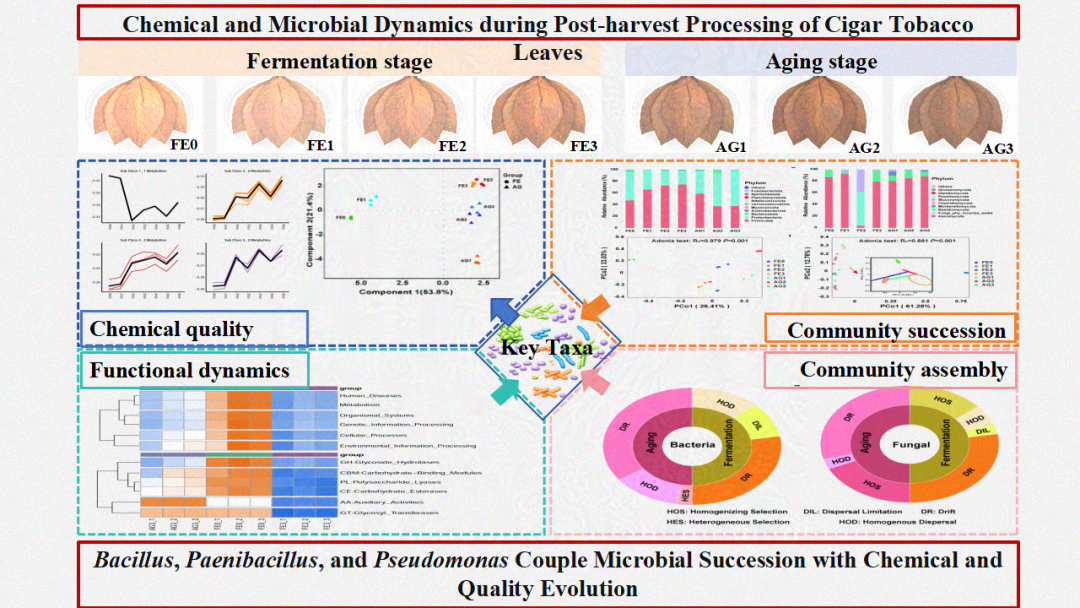
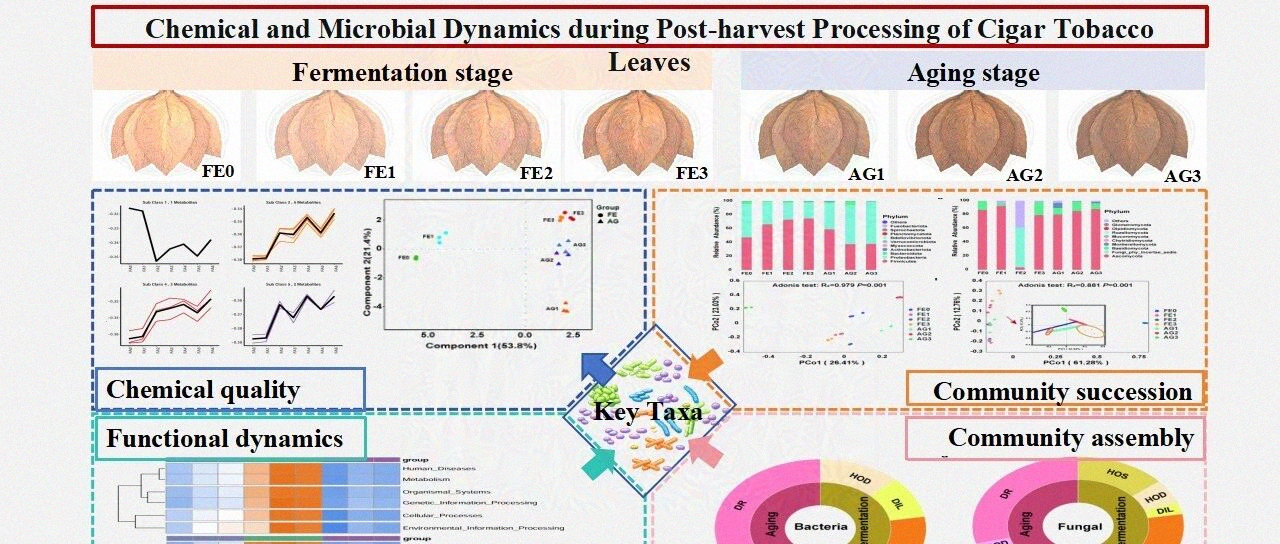
雪茄烟叶的发酵与陈化是决定其香气复杂度和感官品质的关键工序,但驱动化学转化和风味成熟的微生物机制尚不清晰。该研究以国产雪茄烟品种海研101为材料,整合化学分析、扩增子测序和宏基因组学,解析发酵与陈化过程中化学组分、微生物群落演替及功能潜力。研究发现,发酵阶段蛋白质和光合色素降解占主导,而陈化阶段总糖、铵态氮和淀粉显著积累。细菌群落在发酵期以厚壁菌门为主,陈化期向变形菌门转变,真菌群落各阶段均以子囊菌门占优。细菌群落构建以随机过程为主,真菌随陈化呈确定性选择增强的混合组装,且陈化阶段细菌—真菌跨域网络更复杂。细菌对化学品质变异的解释力强于真菌,芽孢杆菌属、近缘杆菌属和假单胞菌属为品质相关核心类群。微生物功能从发酵期的碳水化合物降解向陈化期的氨基酸、脂质和氧化还原代谢转变。该研究将雪茄烟叶化学演化与核心微生物演替和功能转换相联系,为理解微生物—化学动态耦合机制提供了新视角,也为雪茄生产工艺优化提供了潜在微生物调控靶点。
该研究成果得到了河南省科技攻关项目和河南省自然科学基金的资助和支持。
PART
01
相关信息
relevant information

作者:Wei Dai , Shaoxin Yang , Meng Liang , Bin Cai , Bin Wang , Jianchao Wang , Yingxin Wang , Qiannan Zhao , Chunkui Liu a , Yuan He
相关单位:
1.College of Tobacco Science and Engineering, Zhengzhou University of Light Industry, Zhengzhou, 450002, China
2.Jinan Cigarette Factory, China Tobacco Shandong Tobacco Industry Co., Ltd, Jinan, 250100, China
3.Haikou Cigar Research Institute, Hainan Provincial Branch of China National Tobacco Corporation, Haikou, 571100, China
PART
Fermentation and aging are critical stages for aroma formation and quality evolution in cigar tobacco leaves, yet the microbial mechanisms underlying chemical transformation and flavor maturation remain poorly understood. Here, we integrated chemical profiling, amplicon sequencing, and metagenomics to characterize chemical dynamics, microbial succession, functional potential, and their interrelationships. Proteins and photosynthetic pigments predominated during fermentation, whereas total sugars, ammonium, and starch accumulated during aging (P < 0.05). Reducing sugars and petroleum ether extractables accumulated markedly during late aging (P < 0.05). Bacterial communities were dominated by Firmicutes during fermentation and shifted toward Proteobacteria during aging, whereas fungal communities were consistently dominated by Ascomycota across all stages. Bacterial community assembly was primarily governed by stochastic processes, while fungal communities exhibited a mixed assembly pattern with increasing deterministic selection during aging. Cross-domain network complexity increased during aging, indicating increased complexity of bacterial-fungal co-occurrence patterns. Integrated analyses consistently showed that bacterial communities contributed more strongly to chemical quality variation than fungal communities (P < 0.05). Bacillus, Paenibacillus, and Pseudomonas were identified as candidate core taxa closely associated with quality-related chemical transformations. Metagenomic analysis further revealed a functional transition from carbohydrate degradation during fermentation toward amino acid, lipid, and redox-related metabolism during aging. Collectively, these findings link quality-related chemical evolution to the succession and functional shift of candidate core microbial taxa and their potential cross-domain associations, providing mechanistic insights into the coupling of microbial community structure, functional potential, and chemical dynamics, and identifying potential microbial targets for process